
Executive summary
The binding constraint on a lean investment team is not how fast it screens. It is how much of its own market it never sees, and how little of what it does see, it keeps.
- A middle market firm receives roughly 1,000 opportunities a year and gives about 400 a real look. The rest are triaged out on bandwidth rather than on fit. Closing that gap by hiring equates to roughly 3,600 analyst hours, or one to two additional hires to review a population where more than 99 percent will not close.
- A decade of CIMs and offering memorandums sits in folders as PDFs. The information was in the documents but never structured, so questions you should be able to answer in thirty seconds cannot be answered easily.
- Analysts turn over every two to three years, and the firm's reasoning leaves with them. Institutional knowledge is currently a headcount function rather than an asset.
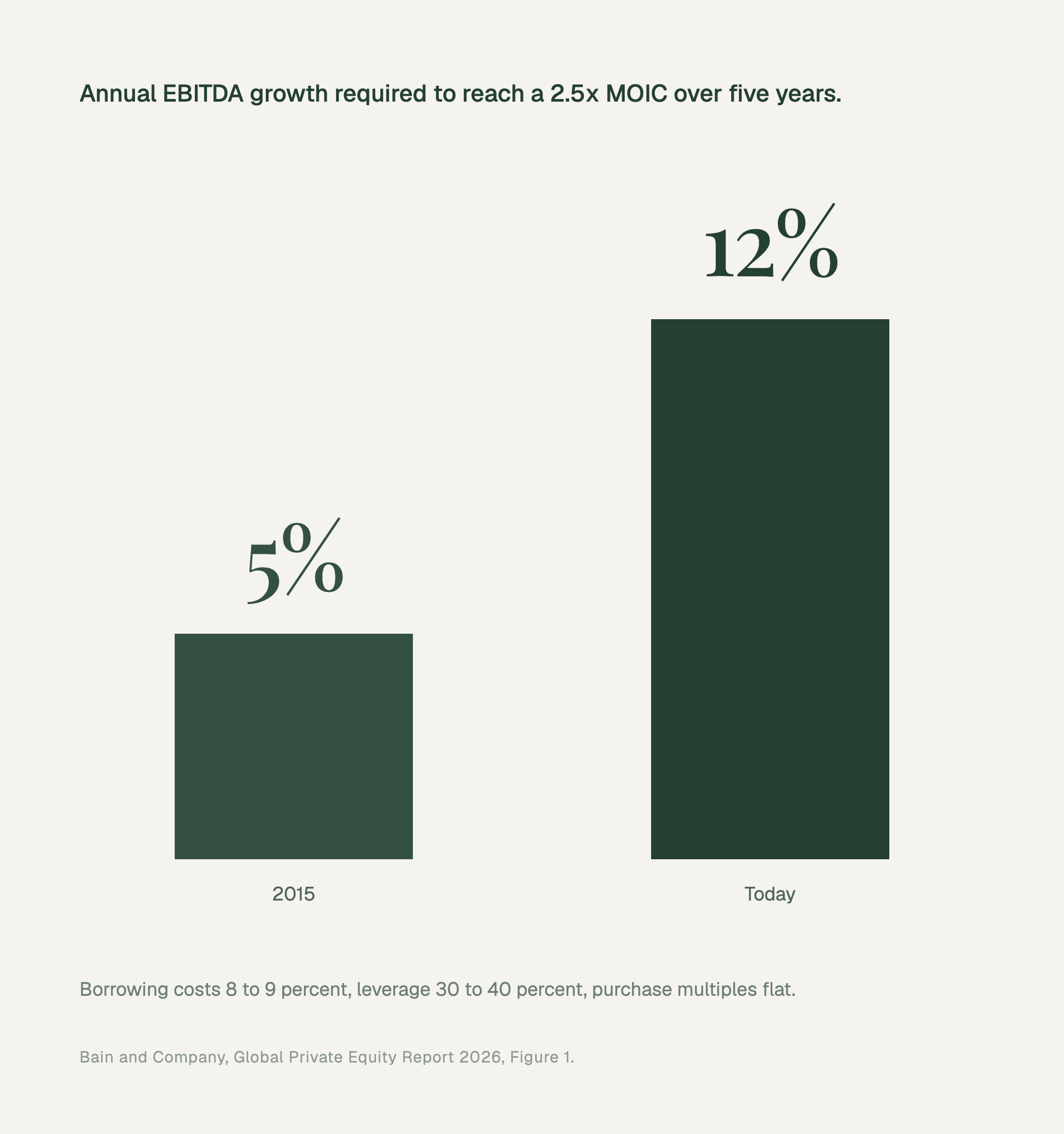
- With multiple expansion not a given, Bain's analysis indicates that achieving comparable returns now requires roughly 10%–12% in annual EBITDA growth, versus about 5% for a 2015 buyout.1 Returns now come primarily from margin expansion in the acquired asset, which makes selection quality and day one execution a requirement.
- A chat tool closes none of it. It runs arithmetic and prose through the same generative mechanism, degrades well before its advertised context window fills, and forgets everything between sessions.
- What closes it is deterministic extraction into a typed record, every figure cited to its source, and a record that persists so the four hundredth deal is screened against everything learned on the first three hundred and ninety-nine.
The metric most firms do not track
Many firms can tell you how many deals reached the investment committee last year, how many went post-NDA, and how many closed. Very few can tell you how many opportunities arrived and never got looked at.
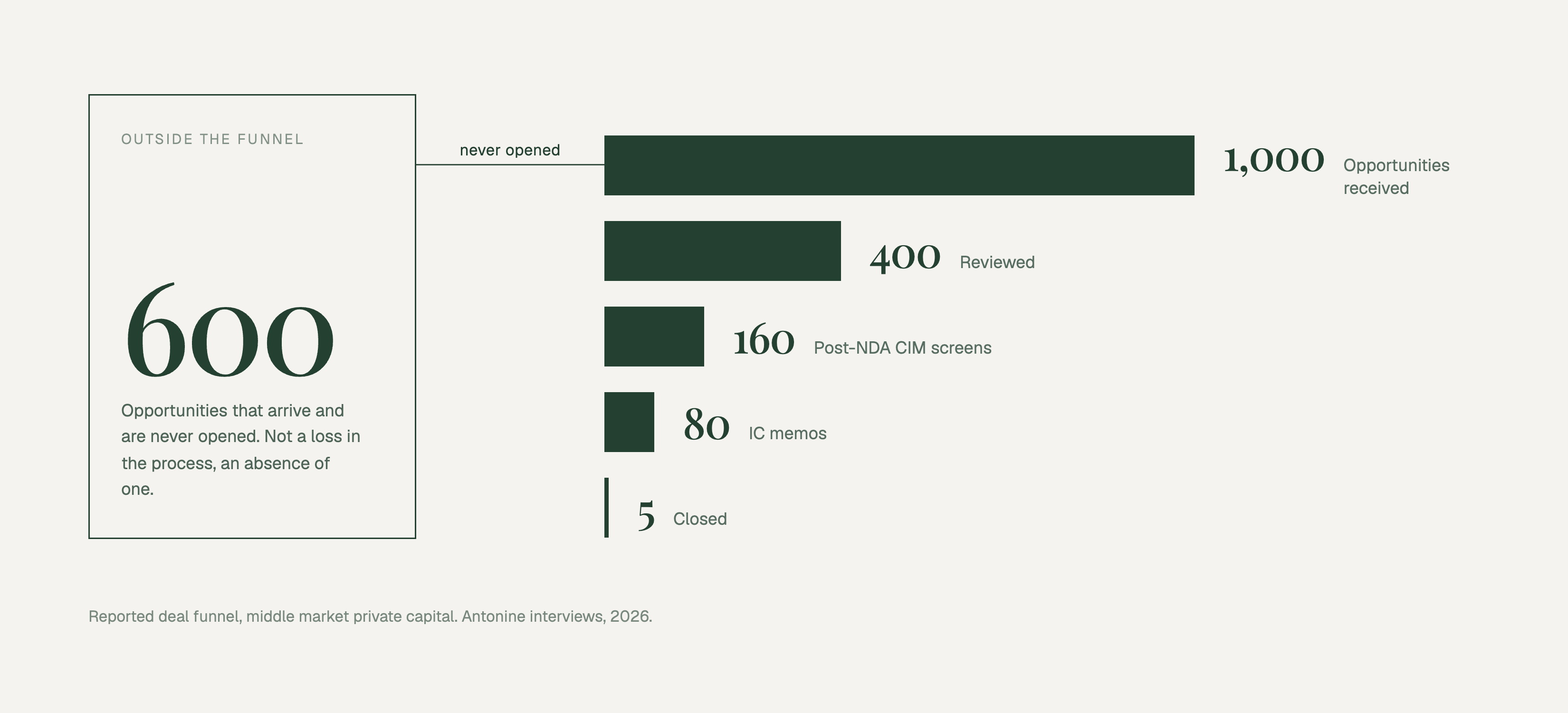
In our interviews with middle market private equity firms and family offices, the same funnel kept showing up. A firm receives roughly 1,000 opportunities a year, arriving as teasers, CIMs or offering memorandums either from bankers or directly from the target Co. About 400 of the deals get a real look. Of those 400, roughly 40 percent go post-NDA to a full package screen, half of those advance to an IC memo, and maybe five close.
Measured from the 400 reviewed, that is a 1.25 percent execution rate, which is normal and healthy. Measured from the 1,000 that arrived, it is 0.5 percent. The gap between those two numbers is 600 deals a year that were not underwritten and declined, and not scored against the mandate and passed. They sat in an inbox until they went stale.
A firm that closes five deals a year out of 400 reviewed has no way of knowing whether its best available opportunity was in the 600 it never opened.
Why screening is expensive
The firms we spoke to put a proper screen at six to ten hours per deal. That covers reading the teaser, the CIM on a corporate deal or the offering memorandum on a commercial real estate property, pulling financials into a model, checking the asset against the mandate, running comparable transactions, and writing up enough of a view for someone senior to make a call.
Six hours is not inefficiency, it is what the work costs when a person does it manually. An analyst covering a live process alongside inbound flow has a fixed amount of bandwidth in a week, and live deal work takes priority every time, as it should. The result is that inbound deal flow gets triaged by who sent it and when it arrived rather than by how well it fits the deal box. Deals are not selected out of the funnel, they get crowded out of it.
Reviewing all 1,000 by hand at six hours each is roughly 6,000 analyst hours a year, which is on the order of two to three analysts besides recruiting, onboarding, and the management load that comes with a larger team. That is real money committed to reviewing a population where, by your own history, more than 99 percent will not close. No investment committee approves that, so the 600 stay a pass and 40 percent coverage becomes a permanent feature of the business.
The analysts are not slow and the team is not understaffed. Manual screening does not scale at any headcount a middle market firm would rationally carry, which is a different problem with a different answer.
Ten years of investor data with no dataset
Ask your team a question you should be able to answer in thirty seconds. Every aerospace & defense company we screened in the last three years under 8x with EBITDA margin above 20 percent. Every multifamily deal in this submarket where the sponsor's exit cap looked light. Every asset where we flagged customer concentration and passed.
The information was in the documents. It was never structured, so today it does not exist in any form you can query. What you have is a folder tree, a deal tracker somebody maintains by hand, and a set of PDFs nobody will open again.
That is the second gap, and it compounds against you. Every deal your team screened was an act of judgment that produced facts, reasoning, and a decision. You kept the facts in a file and lost the other two. The four hundredth deal gets screened with exactly the same information as the first, which is why the screen never gets cheaper and the firm never gets sharper.
Your institutional memory has a two-year tenure
Analysts turn over every two to three years. When they go, their investor mindset goes with them.
You have seen this banker or this broker send thirty packages and formed a view on how they underwrite. You have looked at this sponsor twice before. You passed on a deal in this submarket eighteen months ago for a reason that still applies today. None of that lives in a system. It lives in the mind of whoever was sitting in the seat at the time, and it leaves when they do.
The practical version of this is that a firm's memory is currently a headcount function. It does not accumulate, it turns over. And the same three questions get re-answered by the next person from scratch, at full cost, with less context than the person who answered them last time.
Why this matters more now
Coverage and memory would be nice-to-haves in a market where multiple expansion carried the return.
Bain's 2026 analysis puts the change plainly. A 2015 buyout reached a 2.5x multiple on invested capital on roughly 5 percent annual EBITDA growth, because debt was cheap and multiples were climbing. With borrowing costs now in the 8 to 9 percent range, leverage closer to 30 to 40 percent, and purchase multiples high but flat, the same return takes closer to 10 to 12 percent. Bain's own conclusion is that the winning firms will “build systems, not slogans,” invest in AI and talent, and move from diligence into execution on day one of ownership.2
That changes what a screen is for. When the market lifted every asset, the screen sorted opportunities into yes and no. When the return has to come out of the company itself, the screen has to tell you which specific levers make this company worth more, because those levers are the return and you have five years to pull them.
It also changes what a GP has to be able to do. Ten to twelve percent annual EBITDA growth across a portfolio is operational work, and the most available operational capability right now is AI applied to the workflows inside those companies. A GP cannot credibly deploy that into twelve portfolio companies if it has never run an AI workflow on its own deals. The firms that do this well will be the ones that built the capability on their own documents first, where the risk was theirs and the feedback was immediate.
There is a second effect worth naming. If the reason you bought the company is already structured, the value creation plan does not start from a memo somebody wrote in March. Day one starts from a record.
Why a general model does not solve the problem
Your analysts are already running CIMs and offering memorandums through ChatGPT and Claude. It helps at the margin and it closes none of the three gaps, for three reasons.
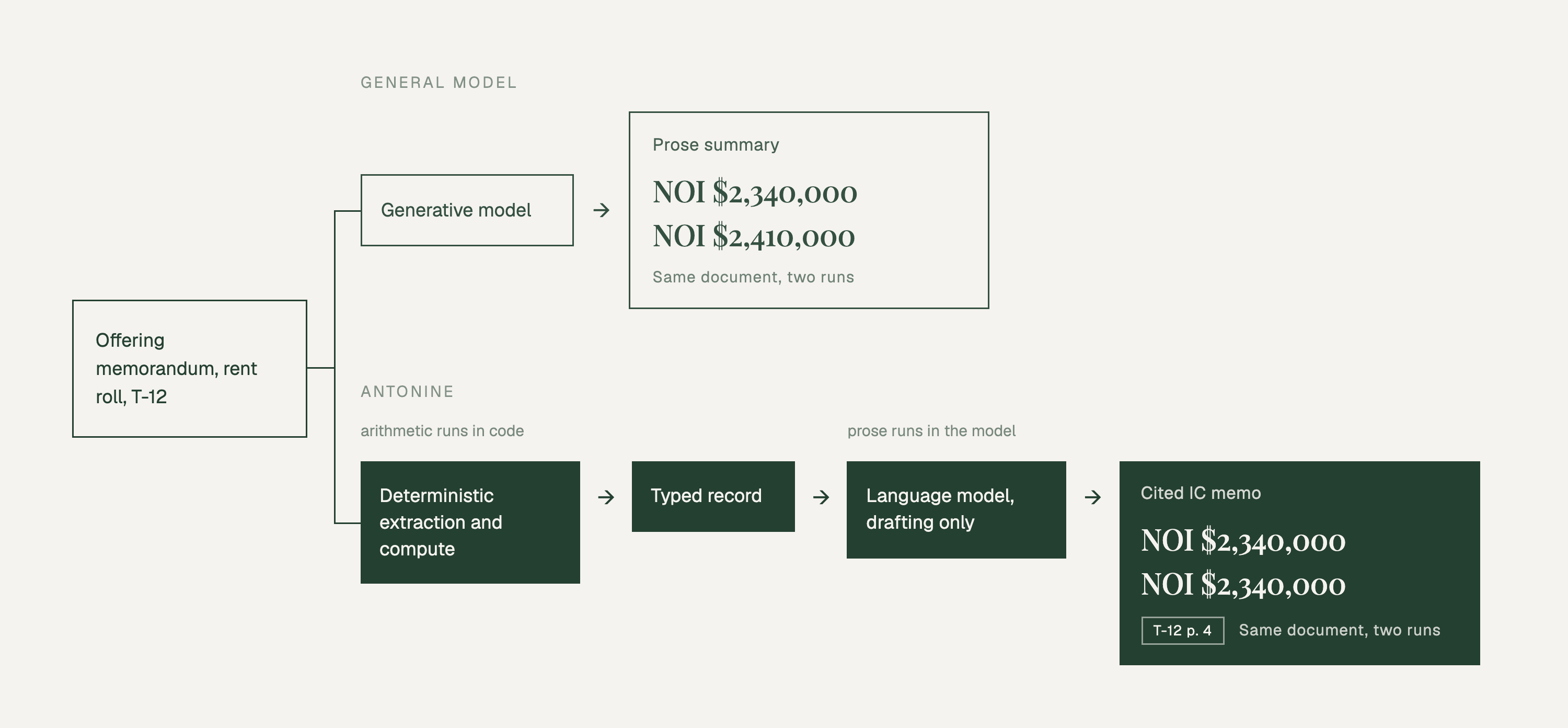
It uses one mechanism for two different jobs. Pulling a number off a rent roll, counting units, cross-footing a T-12, computing a yield, reconciling an IRR from dated cash flows: that is arithmetic, and arithmetic belongs in code, where the same document returns the same answer every time you run it. Framing a risk section, drafting the market narrative, writing a memo a partner will actually read: that is where a language model is better than a person working at midnight, and you should use it. What you want is both, separated, each doing the job it is good at. A chat tool runs both jobs through the same generative mechanism, which is why the number in the summary moves when you run it twice.
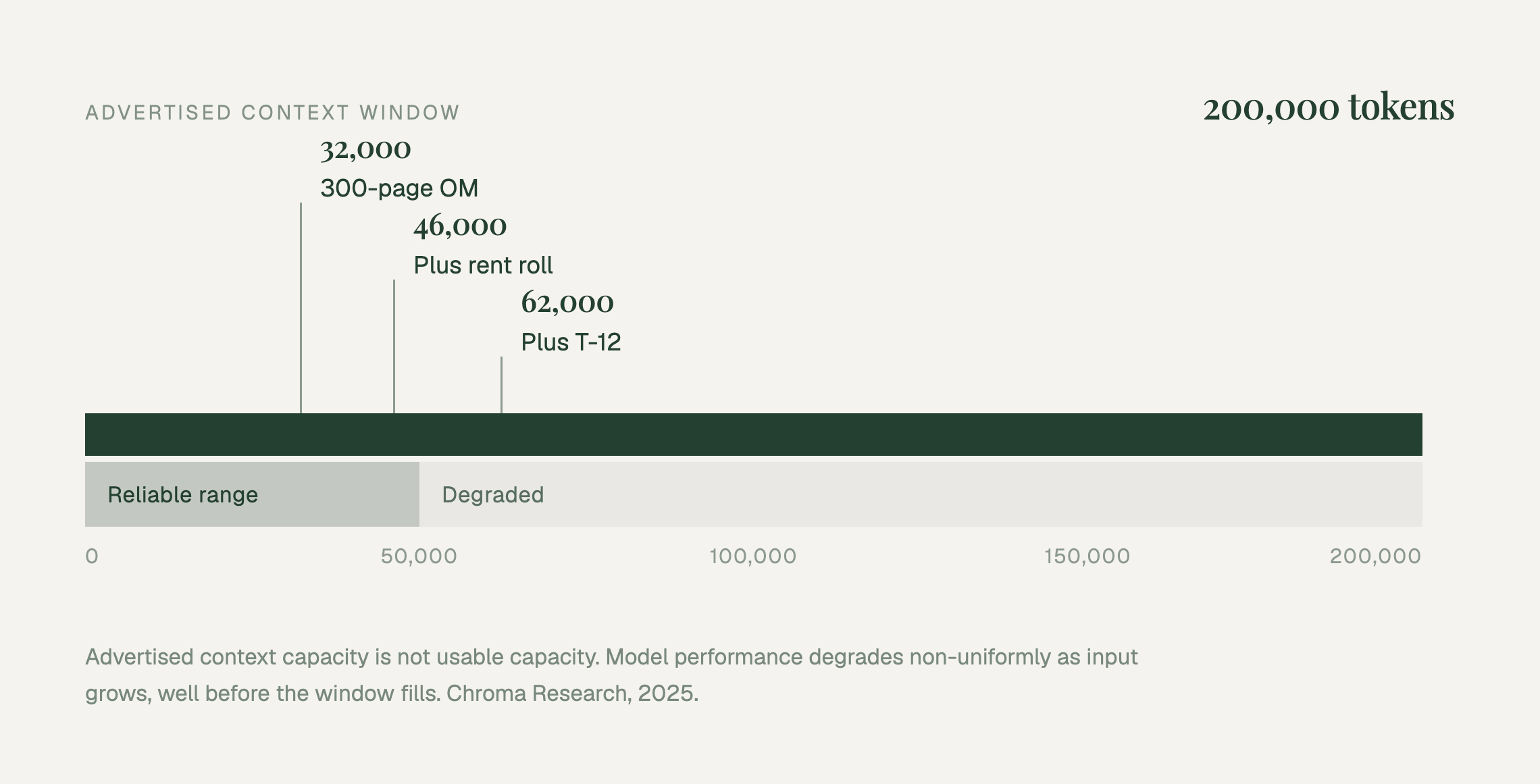
The context window is marketing, not capacity. The advertised million tokens invites you to drop the whole data room into a chat window and ask questions. An October 2025 study, Context Length Alone Hurts LLM Performance Despite Perfect Retrieval, tested five LLMs and found that performance degraded substantially as input length increased, even when the relevant information was perfectly retrieved and remained within the models’ stated context limits. The study found performance degradation ranging from 13.9% to 85% as input length increased.3 A 300-page offering memorandum, a rent roll, and a T-12 can put you squarely in that range, and so can a CIM with a full appendix on the corporate side. The fix is not a larger window. It is retrieving the specific fields you need from a structure, instead of asking the model to reread everything on every question.
It does not know your deal box and cannot learn it. A general model will summarize a CIM or an offering memorandum competently. It cannot tell you the asset resembles the deal you passed on eighteen months ago for a reason that still applies, because it has never seen that pass or the thinking behind it, and nothing you tell it this week is there next week.
What you end up with is a faster first draft. Not more coverage, not a dataset, and not a memory.
What solves the problem
Extraction lands in a typed record rather than in prose. Terms, financials, and risks come out of the documents as structured fields with defined types, whether that is the offering memorandum, rent roll, T-12, and operating statements on a real estate deal, or the CIM and audited financials on a corporate deal. Metrics are computed from those figures rather than generated, so the same document returns the same answer every time, and a rent roll that reports 23 tenants against 21 occupied units surfaces as a conflict rather than passing through as a number.
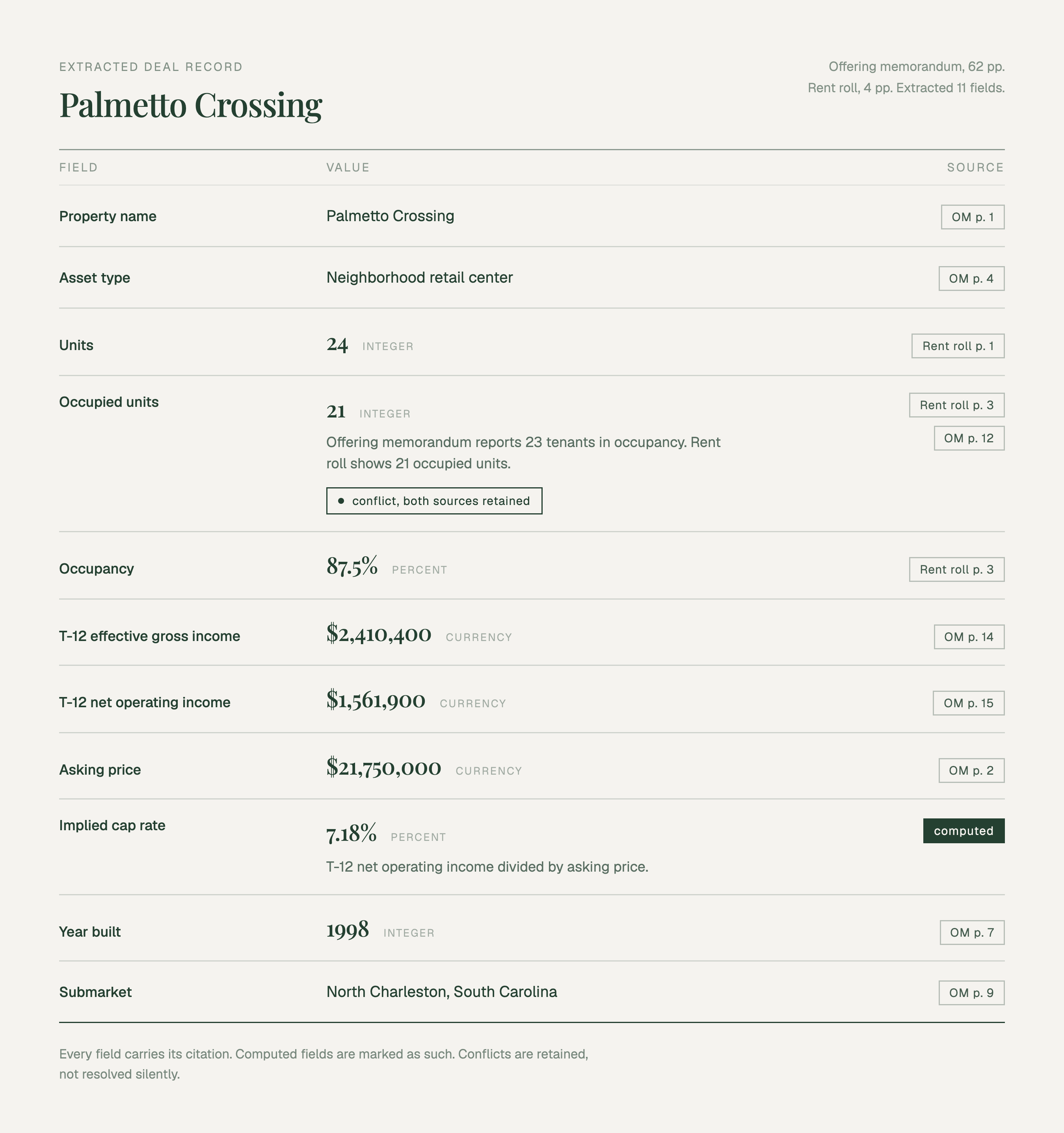
Every figure carries its source. Each number links back to the document, page, and passage it came from, so verification is a click instead of a second pass through the document. This is the step that decides whether the output is usable in front of an investment committee or just interesting.
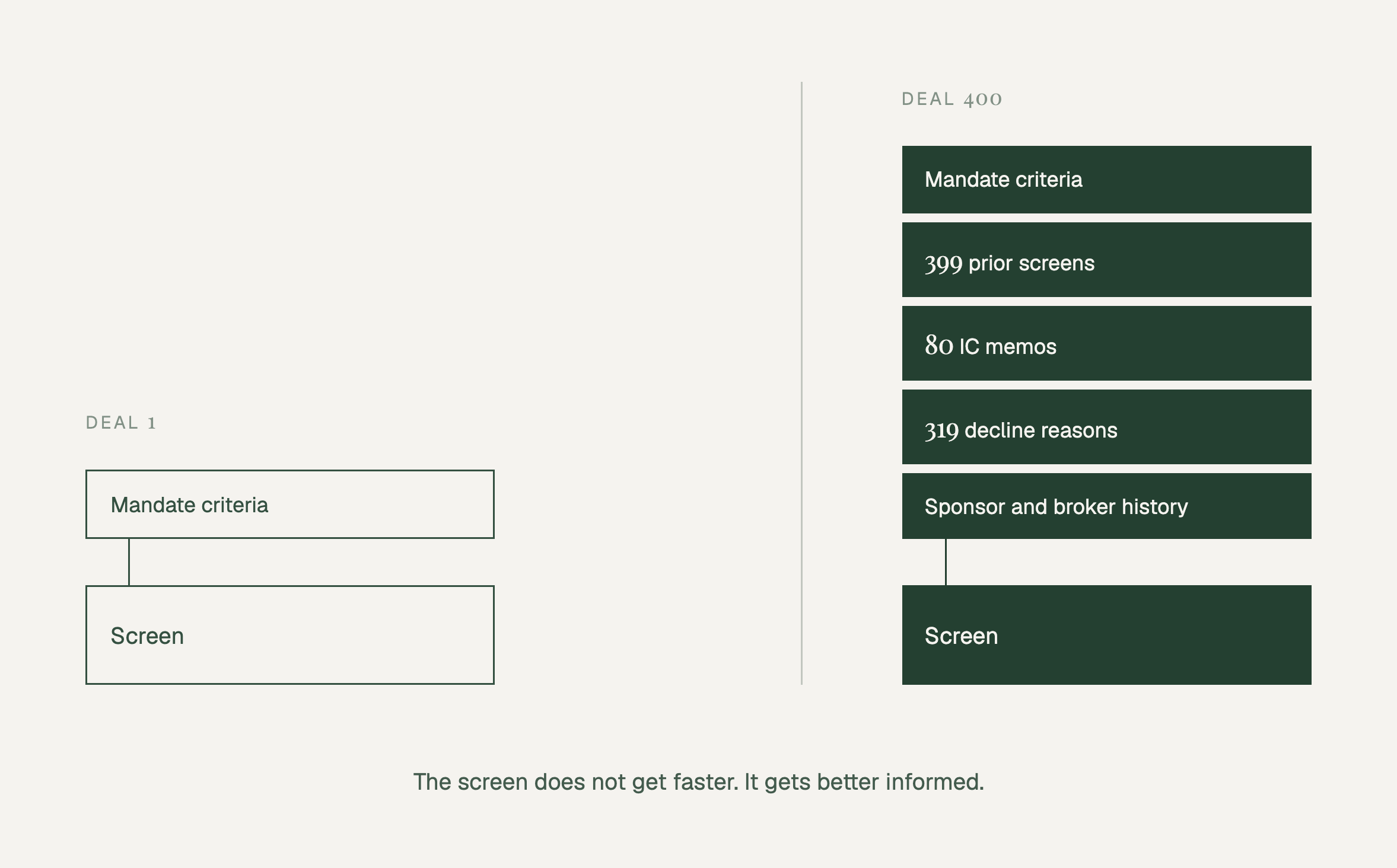
The record persists and compounds. Every screened deal, memo, and decline reason is written to a structure your team can query. The mandate criteria, the pass rationale, the sponsor history, and the historical funnel accumulate instead of resetting. The four hundredth deal gets screened against everything the firm learned on the first three hundred and ninety-nine, and the analyst who joins next year starts from what the firm knows rather than from zero.
That is the difference between a tool that reads faster and a system that gets better. The first one saves an afternoon. The second one is worth more every quarter you run it.
What changes at full coverage
Deals rank by fit against the mandate instead of by arrival order, so the question moves from which opportunities did we have time for to which opportunities were the best. Declines become an asset, because a pass with a recorded rationale sharpens the next screen, survives analyst turnover, and gives you an auditable answer when an LP asks two years later why you did not pursue something. The questions you cannot answer today about your own history become queries. And the 600 become reachable, which they are not now.
Four questions to put to your own team
You do not need a vendor to find out whether this applies to you. Four questions will tell you, and you can ask them this week.
What was our coverage rate last year? Count what arrived against what got a real look.
Pull every deal we screened in the last three years matching three criteria. Pick your own: sector, entry multiple, margin, submarket, sponsor. If the answer takes more than an afternoon, you do not have a dataset, you have a folder tree.
Why did we pass on the last ten deals we declined? If the answer requires calling someone who has since left, your institutional memory is a headcount function.
Which numbers in our last IC memo were computed, and which were generated? Take one figure and trace it back to the page it came from.
Firms that run these four questions tend to find the same thing. The problem is not effort and it is not talent. It is that the workflow produces documents instead of a record, so nothing the team learns is available to the team next time.
What to do about it
If the answers came back the way they usually do, there are three moves worth making in order.
Measure coverage before you fix anything. It is the only number that tells you the size of the opportunity you are currently declining without reading, and it is the baseline every later claim gets measured against.
Separate the two jobs in whatever you use now. Decide which outputs must be identical on every run and which are allowed to be written differently each time. Anything in the first category should never be produced by a language model, whether that is us or anyone else.
Decide where your firm builds the AI capability. Ten to twelve percent EBITDA growth across a portfolio is operational work, and every GP will eventually be asked to bring that capability to its portfolio companies. Building it on your own deals first, where the risk is yours and the feedback is immediate, is cheaper and faster than learning it on someone else's P&L.
Where we come in
Antonine screens every inbound deal against your criteria, drafts the IC memo in your own format, from the offering memorandum, rent roll, and operating statements on a real estate deal or the CIM and financials on a corporate one, with every figure cited to source, populates your underwriting model, and keeps the reasoning behind every decision so the next deal starts from what your team already knows.
The fastest way to evaluate that is not a demo. Send us a deal and a handful of past IC memos, including one you passed on. We will run them through and walk you through exactly how they come out, misses included.
You know how you invest. Your LLM should too.
A note on terminology
We use analyst throughout as shorthand. In practice the work described here is carried by the junior deal team as a whole, analysts, associates, senior associates, and in smaller shops the vice president or principal doing the screen personally. Titles and where the work sits vary by firm size and by asset class. The constraint does not.
We also keep document terminology specific to the asset class rather than using one term for everything. On a corporate transaction the marketed document is a confidential information memorandum, a CIM, and the underlying detail sits in audited financials and a data room. On a real estate transaction it is an offering memorandum, an OM, and the underlying detail sits in the rent roll, the trailing twelve month operating statement, and the operating statements. Where an example is drawn from real estate we say OM, rent roll, and T-12. Where it is drawn from corporate private equity we say CIM. Where the point applies to both, we say so.
Disclaimer
This article reflects Antonine's opinions and the market research we have conducted, including interviews with investment professionals at middle market private equity firms and family offices. Figures drawn from those interviews are self-reported and directional. They describe the firms we spoke with rather than the industry as a whole, and your own funnel may look materially different.
Nothing here is investment, legal, tax, or accounting advice, and nothing here is an offer or solicitation with respect to any security or investment. Do not rely on it in making any investment decision.
Third-party research is cited to its source and remains the property of its authors. We do not own, license, or claim any rights in data published by Bain and Company, Chroma, or any other party referenced, and we make no representation as to its accuracy or completeness. Our summaries are our own characterizations of that work and should not be attributed to those authors. Readers should consult the original sources directly.
Product capabilities described here reflect the platform as of publication and are subject to change. Figures illustrating deal records are composite examples constructed for illustration and do not represent any actual transaction or client.